
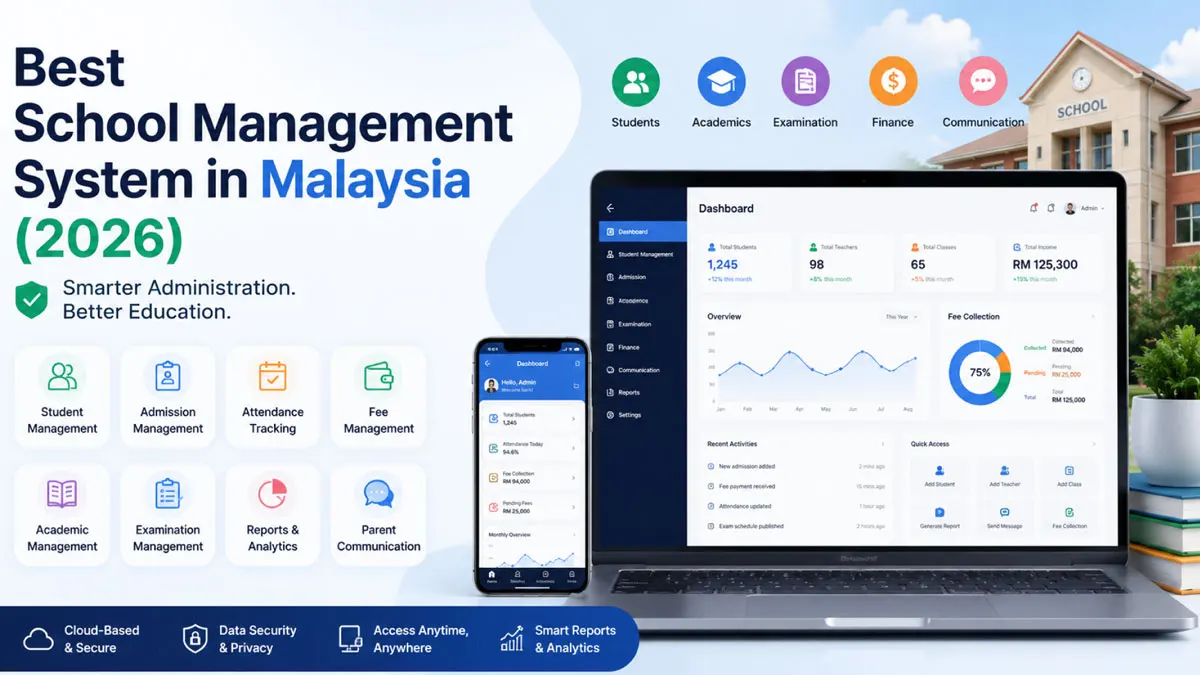
Managing a private school, tuition centre or preschool in Malaysia involves a huge daily juggle. You are forced to maintain attendance books, collect fees, check exam books, reply to parent WhatsApp enquiries, and keep a filing cabinet of unorganized paper forms. That's where a good school management system comes in.
However, this word "good" is important. The education software market in Malaysia was booming and many off-the-shelf student information systems (SIS) developed abroad lacked the understanding of the local realities. They overlook items such as SST invoicing, the report cards in Bahasa Malaysia, and the majority of schools still have the cash collection from the counter.
This guide is a comparison of 5 School Management Platforms that schools can use in Malaysia in 2026. Classroom management tools, Tuition Management System features, Parent communication and Reporting in private schools, Primary schools and Education centres are discussed. Whether you're operating from a single tuition centre or a multi-branch operation, you'll know which system is going to suit you in terms of size, budget and workflow.
School Management System - What to Check out in a School Management Software?
When you are comparing products, you should be aware of what is important. In Malaysia, the majority of schools who are assessing a learning management system or an ERP system do it by price, but end up regretting it. Do a quick self-check if you have not done so already:
Local compliance: Invoices that meet SST standards and report formats compatible with MOE.
Fee and billing automation: Recurring tuition fees, late fees reminders, and receipts Attendance and classroom management: daily attendance, timetabling and handling of substitutes.
Parent communication: more than email bulletins, an app or a portal.
Data ownership: be able to export data to other vendors when you change.
Support responsiveness: locally based support team, rather than an overseas ticketing queue.
Have this list on hand. This is the lens for each of the platforms below.
1. Local All in One Platform (Malaysia ERP System).
There are a few ERP software Malaysia schools are using every day as they are developed by several software companies in Malaysia. This was no ordinary product design that was simply copied from around the world. These platforms group certain of these tools into bundles:
Enrolment, academic records and report card system.
A tuition management system that offers SST ready invoicing and payment gateways online like FPX or e-wallets.
Tools to help manage classroom schedules, attendance and homework, parents app.
These are best suited when the private school, primary school, and tuition centres seek a single vendor to take care of all. You receive assistance from staff who are familiar with the school calendar and payment expectations in Malaysia.
One of the biggest reasons that schools select a system: the demo.One of the most common reasons schools select a system: the demo. Do not do that. Request an in-person tour of the finance module rather than just a look at the dashboard.
2. LMS on the cloud with a local reseller
There are certain international platforms which provide services in Malaysia via its local partners. These platforms have great learning management software characteristics such as assignments, gradebooks, and LMS integration for online classes. But they are less strong in local admin requirements such as SST invoicing or the localised Bahasa Malaysia templates.
These are suitable for international schools or education centres which are already in use a global curriculum framework. They're effective where classroom and LMS tools are more important than local billing quirks.
Be aware of any pricing in USD or SGD. The rates vary with exchange rates. Support hours may not be aligned with the Malaysian working hours.
3. Professional tuition centre management systems
The requirements of tuition centres vary from those of full day schools. Smaller class sizes, multiple subject streams, and fee terms are according to a per-subject or per package basis. A tuition management system that is dedicated to certain features:
Subject and level scheduling of classes.
Billing based on packages or per-session.
Remind students with SMS or WhatsApp for make-up classes.
Easy-to-use parent portals for details on fees.
These may be used for standalone tuition centres, enrichment centres. They are helpful when preparing students for UPSR successor assessments or SPM.
What's the difference between School ERP and Tuition Management System?
A school ERP handles all academic activities such as admission, timetabling, exams, HR etc. A tuition management system is specific and only deals with class scheduling and fee billing at smaller subject-based centres.
4. Manage documents, records, and information systems
There are some schools that are more concerned with the document management features than the flashy dashboards. This occurs a lot when schools are handling accreditation documents or have multiple branches. These systems are dedicated to particular tasks:
Centralized repository of student files, contracts, and compliance documents. No need of physical files when searching for documents.
These are education groups that fit with multiple branches. They also serve in schools that are preparing for audit and accreditation renewal that do not necessarily need to have features that parents will find exciting.
Don't wait until last minute to manage documents. The report cards from 3 years ago are strewn around staff's laptops, so you will need to climb to access them.
5. Systems for the growth of admissions and enrollments based on the CRM paradigm.
The newer type combines CRM software and school operations. This will assist with hard competition in education centres and private schools. These systems capture leads from parent enquiries, follow up with them automatically and turn them into enrolment.
Afterwards, they pass the information over to the academic part of the platform.
They work for all preschools, private schools and education centres in competitive areas.
They are a valuable asset when admissions marketing is as vital as classroom operations.
Quick comparison table
| Category | Strongest at | Weakest at | Best fit |
|---|---|---|---|
| Local ERP platforms | SST billing, local support | Advanced LMS features | Private and primary schools |
| Global LMS + resellers | Classroom and LMS depth | Local billing, FX pricing | International schools |
| Tuition-specific systems | Flexible fee billing | Full HR and ERP scope | Tuition centres |
| Document-focused systems | Compliance, audit trails | Parent engagement tools | Multi-branch groups |
| CRM-led systems | Admissions conversion | Deep academic records | Growing and competitive centres |
How homeschool co-ops and small centres fit in.
Home schooling in Malaysia is steadily increasing. A significant number of co-ops operate in a similar way to small education centres, and they organise support from several families, several tutors and coordinated resources.
These groups are best started by using a lightweight tuition or classroom management tool.
If the group becomes a registered centre, a full ERP can be implemented in the future.
When selecting a school management system, there are some common pitfalls that can be easily avoided.
Withholding the right to export data: Double check whether you can get your student records if you switch vendors later.
No demonstration on the parent side: Admin staff may enjoy a system which is not easy for parents to log into.
Not estimating training time: Even the "intuitive" software is going to require a proper onboarding process for teachers.
Going with the lowest price: The lowest price is not always associated with the ability to issue SST-compliant invoices, resulting in additional manual labour later on.
Failure to check support language and hours: You should have both Bahasa Malaysia and English support during Malaysian business hours.
Frequently Asked Questions
Conclusion
Selecting a school management software in Malaysia ultimately boils down to finding the right software for your operation. A tuition centre or a home schooling co-op will not have the same needs as a full private school. Make sure you first look for local SST compliance, effective parent engagement solutions, and data export options before signing up with any vendor.
When looking around, first identify your 3 most frustrating tasks as a parent, such as collecting fees, checking attendance, or staying in touch with parents. Don't use a long list of features, use that shape to guide your shortlist. In most schools that change systems twice, it is because of that one step.