
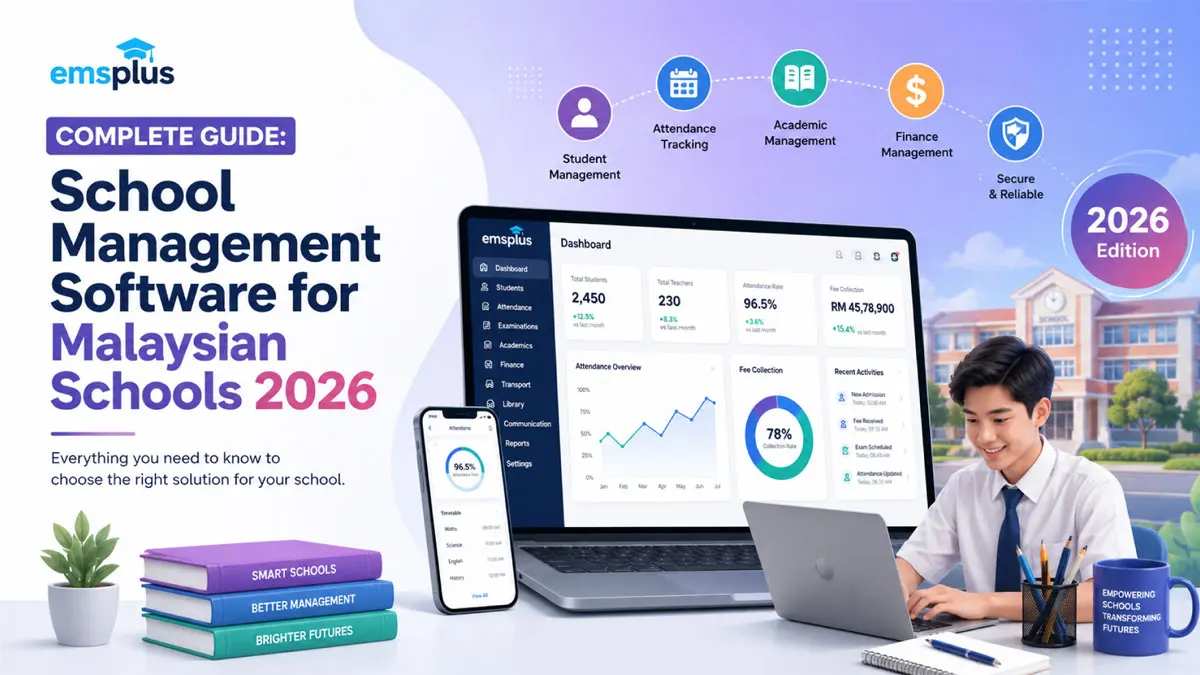
Education in Malaysia goes digital a bit more every year. Private schools, international schools, preschools, colleges, and tuition centres all face the same exact pressure. You have to deliver faster services, talk to parents more often, and manage a massive pile of student data without hiring extra admin staff.
Many schools still lean on spreadsheets, paper records, and disconnected software to handle admissions, attendance, and finance. Those tools eventually create duplicate records and force you to run manual reports. You end up with inconsistent data and painful administrative delays as your campus grows.
A modern School Management System brings every single department into one connected digital platform. Administrators, teachers, finance teams, HR departments, and parents all work from the exact same real-time information.
This creates an education environment where hard data backs up your decisions. Routine tasks run automatically, and real collaboration across the entire campus actually happens.
You might manage a tiny preschool or a massive multi-campus international school. Choosing the right ERP software Malaysia solution cuts down your workload, tightens up communication, and gets your institution ready for future growth.
Malaysian schools need to understand the core components of modern school management software, the daily operational improvements it brings, and the specific factors to check before buying a solution.
What is school management software?
School Management Software is a centralized digital platform. It helps educational institutions manage their academic, administrative, financial, and operational activities straight from one system.
Every department works inside a connected environment where information updates automatically.
A typical digital workflow looks like this:
Data naturally flows across departments exactly when someone needs it. Once a student finishes admission, their profile immediately pops up in the attendance module, finance department, examination system, library, and parent portal. No one types that data twice.
Modern platforms bolt several technologies together into one ecosystem, including:
- Student Information System (SIS) for managing student records.
- Campus Management System for coordinating daily school operations.
- ERP Software for finance, HR, administration, and reporting.
- Learning Management Software for supporting classroom learning and assignments.
- CRM Management Software for admissions enquiries and parent communication.
Many modern education platforms combine all these functions into a single shared solution.
Why Malaysian schools are investing in ERP systems
Schools across Malaysia are dealing with heavy operational changes. Student enrolment keeps climbing, and parents expect instant communication. Administrators absolutely need reliable information to make fast decisions.
These pressures push institutions to drop disconnected processes and buy integrated ERP System Malaysia solutions.
The specific reasons change depending on your type of institution.
Private schools
Private schools handle multiple fee structures, extracurricular activities, transportation services, and parent communications. Keeping track of these moving parts manually gets miserable as enrolment climbs. An integrated ERP simplifies administration and gives you a clear view of daily operations.
International schools
International schools usually run multiple curricula for diverse student populations and families from all over the world. A centralized system helps you manage admissions, academic reporting, finance, attendance, and communication consistently. It keeps every department running on the same international operational standards.
Preschools
Preschools need simple, reliable tools for attendance, billing, student records, and parent engagement. Digital platforms strip back the paperwork and make daily communication dead simple for both teachers and parents.
Tuition centres
Tuition centres run flexible schedules, varied subject combinations, and recurring monthly billing. A centralized management platform completely automates scheduling, attendance tracking, fee collection, and student records. You handle the workload without hiring more front-desk staff.
Colleges and higher education institutions
Higher education institutions manage massive student populations, multiple faculties, heavy examination schedules, and complex resource allocation. Integrated management systems help departments collaborate and hand leadership hard operational data.
The shift toward connected school operations
Modern schools look for platforms that wire everyday operations into one digital ecosystem. Information moves freely between departments instead of getting trapped inside separate applications.
For example:
- Admissions data automatically creates student profiles.
- Student records become available for attendance and examinations.
- Finance teams generate invoices using existing student information.
- Parents receive updates through connected communication tools.
- School leaders access live dashboards without waiting for someone to build a manual report.
- AI-assisted administrative workflows
- Predictive student performance analytics
- Automated fee collection and financial forecasting
- Smart attendance tracking using RFID or facial recognition
- Mobile-first parent and teacher communication
- Integrated learning management software
- Advanced dashboards for hard-data leadership decisions
Schools spend way less time fixing errors when departments share the exact same information.
You get to spend those hours actually improving educational outcomes.
This connected approach naturally supports long-term digital growth. Malaysian schools can easily build new campuses, launch new programs, and meet new educational requirements ithout tearing down their whole administrative setup.
Core modules every modern school ERP should include
Every school has slightly different priorities, but the backbone of a good School Management System stays the same. The best ERP platforms wire every department together through a shared database so information flows automatically across the campus. You get to manage everything from one platform.
The table below lists the essential modules every modern ERP Software Malaysia solution should provide.
| ERP Module | Purpose |
|---|---|
| Admission Management | Simplifies enquiries, applications, enrolment, and student onboarding. |
| Student Information System | Stores academic, personal, medical, and administrative student records in one place. |
| Attendance Tracking | Records attendance digitally and generates real-time attendance reports. |
| Finance Management | Manages fee structures, invoices, online payments, receipts, and financial reporting. |
| Learning Management Software | Supports assignments, homework, digital resources, and classroom collaboration. |
| Examination & Assessment | Handles grading, report cards, examinations, and academic progress tracking. |
| HR Management | Organizes employee records, payroll information, leave management, and staff documentation. |
| Library Management System | Tracks books, borrowing history, returns, and inventory efficiently. |
| CRM Management Software | Manages parent enquiries, admissions follow-ups, and communication workflows. |
| Reporting & Analytics | Provides dashboards and operational reports for informed decision-making. |
These modules become massively useful when they actually talk to each other. Information entered once becomes permanently available wherever someone needs it.
When a new student completes admission, their profile automatically populates the attendance system, finance module, library management system, examination records, and parent portal.
This kills duplicate data entry entirely and keeps records identical across the school.
How school management software improves daily operations
The real advantage of an integrated ERP comes down to how smoothly information moves from one department to another.
Administrators often burn hours transferring information between spreadsheets, building reports manually, and chasing down different departments for updates. A connected system wipes out these repetitive steps. Every single team just accesses the exact same real-time information.
Choosing the right ERP for your school
A preschool runs on completely different operational requirements than a multi-campus nternational school. A tuition centre operates differently from a college or university. Schools need to evaluate whether a platform directly supports their long-term operational goals.
A structured evaluation helps decision-makers lock in on the specific factors that continue delivering value as the institution grows.
| Evaluation Criteria | Why It Matters |
|---|---|
| Scalability | Supports increasing student enrolment, new programmes, and additional campuses without replacing the system. |
| Cloud Infrastructure | Provides secure access from anywhere while reducing hardware and maintenance requirements. |
| Ease of Use | Encourages faster adoption by teachers, administrators, and finance teams. |
| Local Support | Ensures quicker assistance, implementation guidance, and training when required. |
| System Integration | Connects admissions, finance, HR, attendance, and academic records into one platform. |
| Data Security | Protects sensitive student and employee information through secure access controls and backups. |
| Reporting & Analytics | Provides accurate operational insights for better planning and decision-making. |
| Mobile Accessibility | Allows parents, teachers, and administrators to access important information using smartphones or tablets. |
Pricing obviously matters. It just shouldn't be your only deciding factor.
A cheaper solution usually forces you to buy third-party applications, run manual reports, and take on heavy administrative work later. A well-integrated ERP platform actively reduces operational complexity by replacing a bunch of disconnected systems with one centralized tool.
You also have to consider how easily the software adapts to future demands. Educational institutions naturally evolve. You introduce new academic programs, build new campuses, upgrade parent engagement, and roll out digital learning tools. Picking a platform that handles those changes saves you from a massive, expensive system replacement in a few years.
The right ERP aligns perfectly with your operational processes, supports long-term growth, and gets every department working from the same reliable data source.
Choosing the right school management software for your school type
Schools in Malaysia operate differently, so the same software naturally won't fit everyone. A preschool, tuition centre, international school, and higher education institution all tackle very different administrative priorities. Choosing a platform that matches your specific daily operations always beats buying the one with the longest feature list.
The table below outlines what different institutions typically need.
| Institution Type | Primary Operational Focus | Essential Software Features |
|---|---|---|
| Preschool | Student safety and parent communication | Attendance tracking, parent app, digital billing, classroom updates |
| Primary & Secondary Schools | Academic administration | Student information system, examinations, attendance, finance, reports |
| International Schools | Multi-curriculum management | Multi-campus support, flexible grading, admissions, compliance, communication |
| Tuition & Coaching Centres | Class scheduling and recurring fees | Timetable management, attendance, package billing, online payments |
| Colleges & Universities | Large-scale administration | Academic records, HR, finance, reporting, learning management integration |
Selecting software tailored to your institution keeps things simple and gets your staff actually using the system from day one.
The future of school management software in Malaysia
Education technology keeps shifting. Modern school management systems operate as intelligent, heavy-duty operational platforms.
Over the next few years, Malaysian schools can expect ERP software to pack in heavy automation, predictive reporting, and tightly connected digital services.
Some emerging capabilities include:
Cloud ERP solutions let you bolt on new features without dropping cash on hardware upgrades.
Schools get continuous improvements through regular updates while keeping their data completely secure.
Institutions buying scalable systems today put themselves in a great spot to handle curriculum changes, rapid enrolment growth, and shifting parent expectations.
Frequently Asked Questions
Conclusion
Managing a modern educational institution requires a tightly integrated platform that connects every single department. You need tools that improve collaboration and serve up accurate information for hard decision-making.
The right School Management Software helps Malaysian schools chop down their administrative workload and tighten up communication. It strengthens your financial management and hands a much better experience to your students, parents, teachers, and admin staff.
You might operate a preschool, private school, international school, tuition centre, or massive university. Buying a scalable ERP System Malaysia solution functions as a massive long-term decision that directly supports your operational efficiency and future growth.
Focus on finding a platform that specifically aligns with your school's goals, wires into your daily operations, and grows right alongside your institution. Setting up a solid implementation today builds a highly connected educational environment for years to come.