
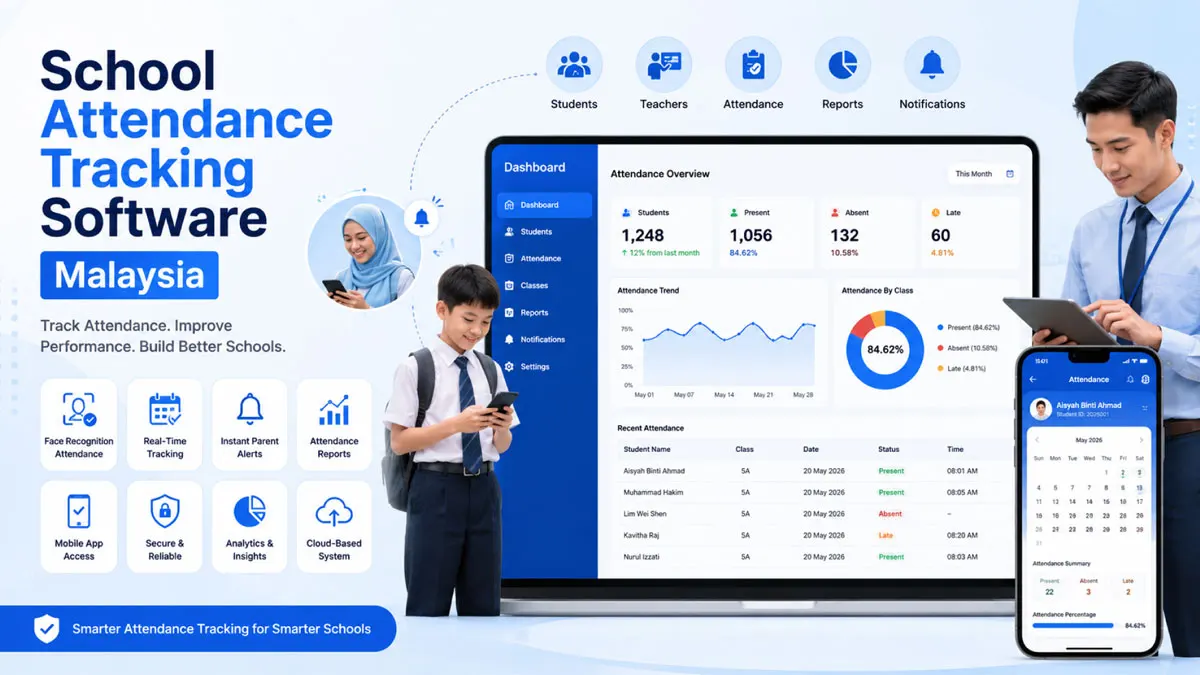
Teachers take attendance first thing every morning. The data they collect drives classroom management, parent communication, student wellbeing, and administrative reporting.
Most Malaysian schools already dropped paper registers for digital tools. Buying software rarely fixes a broken daily routine on its own. Disconnected data still forces administrators to waste hours on repetitive manual work.
A good school attendance tracking software Malaysia setup automates the whole job. It records attendance, texts parents, updates student profiles, and builds reports instantly. Teachers get back to teaching. Administrators get out of the paperwork pile.
This guide breaks down how Malaysian schools automate student attendance management. You can apply these steps to a private school, an international campus, a tuition centre, or a preschool. These strategies build a fast, reliable daily routine.
Step 1: Review your current attendance workflow
Schools need to map their current routine before buying any technology. Administrators often buy software without locating where their delays actually happen.
Writing down the exact daily routine exposes the bottlenecks you need to fix.
A standard daily process looks like this:
You usually find hidden delays between every single stage.
For example :
- Teachers submit attendance after the first lesson finishes.
- Administrative staff consolidate classroom records by hand.
- Parents get absence alerts hours after the bell rings.
- Staff build reports manually at the end of the week.
These gaps pile extra work onto the admin team. School leaders wind up making decisions with outdated numbers.
Step 2: Establish consistent attendance policies before automation
Technology only works when every department plays by the same rules.
Schools constantly struggle with inconsistent recording habits. Teachers interpret categories differently. One teacher marks a tardy student as absent, while another marks them as a late arrival.
Those minor choices destroy the accuracy of your school's data over time.
You need clear rules before you launch a student attendance management system.
A standard policy includes:
| Attendance Status | Example |
|---|---|
| Present | Student attends all scheduled classes. |
| Late Arrival | Student arrives after the official start time. |
| Excused Absence | |
| Unexcused Absence | Student absent without prior notification. |
| School Activity | Student attending an official school programme. |
| Early Departure | Student leaves school before the scheduled end time. |
Data becomes reliable the moment you force everyone to use the same definitions.
You also need written procedures for:
- Recording attendance during substitute classes.
- Managing field trips and extracurricular activities.
- Processing leave requests.
- Correcting attendance records.
- Approving attendance adjustments.
- Managing attendance across multiple campuses.
Clear rules remove the guesswork. Every teacher follows the exact same steps.
This structure fixes parent communication too. Uniform statuses trigger accurate notifications.
School leaders finally get operational reports they can trust.
A rigid framework leads to better institutional decisions.
Step 3: Connect attendance with your school management system
Schools often record attendance digitally but keep their student records and communication tools completely separate. You end up doing the same work twice and creating data errors.
A connected school management system pushes data directly to the people who need it.
Everyone works from the same live database.
A connected workflow looks like this:
Connecting your tools gets administrators out of the data entry business. They have more time to actually support students.
A teacher marks a student absent, and that status hits the student's profile instantly. The admin team sees the update without waiting for a paper slip.
A connected student attendance management system hooks directly into:
- Student information records
- Classroom management schedules
- Parent communication portals
- Academic reporting
- School administration dashboards
- Tuition management systems for attendance-based billing
Attendance becomes the engine that drives your daily operations.
Step 4: Automate parent communication
Parents expect fast updates about their kids.
Calling them at the end of the day delays serious conversations. You need to know immediately if a student misses class unexpectedly.
Automated messages give parents transparency and cut your staff's workload.
Your automatic triggers can include:
- Absence notifications
- Late arrival alerts
- Daily attendance summaries
- Approved leave confirmations
- Attendance history updates
- School announcements linked to attendance events
A student skips first period. The system checks for an approved leave request. If it finds nothing, it flags the school staff. The software texts the parents through the school app the second a teacher confirms the absence.
This kills the afternoon phone call marathon. Staff avoid manual follow-ups, and families know exactly what is happening in real time.
Consistent updates build trust. Parents never have to guess if their kid made it to class.
Step 5: Turn attendance records into meaningful school insights
Data helps you fix operational problems.
School leaders track trends throughout the year to catch issues early. Monthly reviews hide immediate problems.
Your dashboard needs these reports:
| Attendance Report | How It Supports School Operations |
|---|---|
| Daily Attendance Summary | Provides a real-time overview of student attendance. |
| Class Attendance Report | Identifies attendance patterns across classrooms. |
| Individual Student History | Tracks long-term attendance records for each student. |
| Attendance Trend Analysis | Flags recurring absenteeism or seasonal patterns. |
| School-wide Attendance Dashboard | Supports leadership planning and operational monitoring. |
Administrators use these numbers to answer hard questions:
- Which classes have consistently lower attendance?
- Are attendance patterns changing during examination periods?
- Which students need extra academic or wellbeing support?
- How well do your attendance initiatives actually work?
Teams use attendance data to make sharp operational decisions.
The numbers feed directly into the larger education system. Leaders get a totally clear view of student engagement.
Step 6: Monitor and improve your attendance process
You are never completely finished building your workflow. Schools have to evaluate their systems regularly to find dead weight.
Your process has to adapt. Enrolment jumps. New programmes launch. You open a second campus. Your old procedures will break if you refuse to adjust them.
Routine checks keep your records accurate and your staff happy.
Watch these specific areas:
| Review Area | Why It Matters |
|---|---|
| Attendance Accuracy | Keeps student records reliable and consistent. |
| Teacher Adoption | Confirms attendance is recorded correctly across all classrooms. |
| Parent Notification Delivery | Verifies alerts and updates reach parents on time. |
| Administrative Efficiency | Measures time saved by cutting manual tasks. |
| Attendance Trends | Identifies patterns that require academic or student wellbeing support. |
| System Performance | Verifies the attendance platform continues operating smoothly. |
Talk to your teachers and parents. Ask them if the app actually makes their morning routine easier.
Fix small bugs in October. Don't wait for a massive system failure in May.
Automation is a permanent habit. Treat it like one.
Best practices for successful attendance automation
The best campuses bolt good software onto strict daily habits.
Here are the core rules:
- Record attendance at the exact same time every school day.
- Force every classroom to use the identical attendance categories.
- Train your teachers on the software before launch day.
- Read your attendance reports weekly.
- Tell parents exactly how the notification system works.
- Lock down record access with strict user permissions.
- Comb through the data constantly to find operational leaks.
These habits lock in a reliable process for your academic and administrative teams.
Frequently Asked Questions
Conclusion
A solid school attendance tracking software Malaysia setup handles far more than the morning roll call. It feeds live, accurate information directly to teachers, parents, and administrators.
Schools cut their administrative workload by mapping their workflows and setting rigid policies. You connect attendance to your main school management system, automate your messages, and use the data to make fast operational decisions.
A properly built student attendance management system creates a highly organized campus. Any private school, international school, preschool, or tuition centre can use these steps to build a reliable routine that actually supports the Malaysia education system.